Diving into Jupiter: the fluid dynamics of three-dimensional Jovian vortices including the Great Red Spot
Understanding the 3D structure of Jovian vortices using numerical simulations
My Ph.D. thesis investigates the dynamics of Jovian vortices. While the observation of these exceptionally long-lived features dates back to Robert Hooke in 1665 (with the Great Red Spot (GRS) continuously monitored since 1857), historical analysis has primarily been restricted to tracking two-dimensional surface cloud features. Only recently have instruments like Juno and JWST provided indirect evidence regarding the vertical structure and deeper levels of the GRS. Despite these advancements, robust observational data about these vortices’ 3D structure remains sparse.
Modeling the evolution of these vortices is challenging because the timescales on Jupiter vary dramatically. For example, the buoyancy timescale is ~10 minutes, the Coriolis timescale is ~10 hours, and the vortex turnaround timescale is ~5 days. The fast dynamics make long-term direct simulation of Jovian vortices prohibitively expensive. I have developed our group’s home-grown pseudo-spectral-method-based code to handle the complexities of Jupiter’s atmosphere. This encompasses its notable compressibility (referred to as anelastic flow in fluid terminology) and phenomena that span a broad range of timescales. Using this new method, our work on the three-dimensional structure of Jovian vortices was published in the Journal of Fluid dynamics. Based on numerical simulation and stability, we predict that Jovian vortices should has a varying area as a function of depth, like an ice cream.
The following summarizes my study on the fluid dynamics of these Jovian vortices. This is a slide-only recording with no audio narration.
References
2024
-
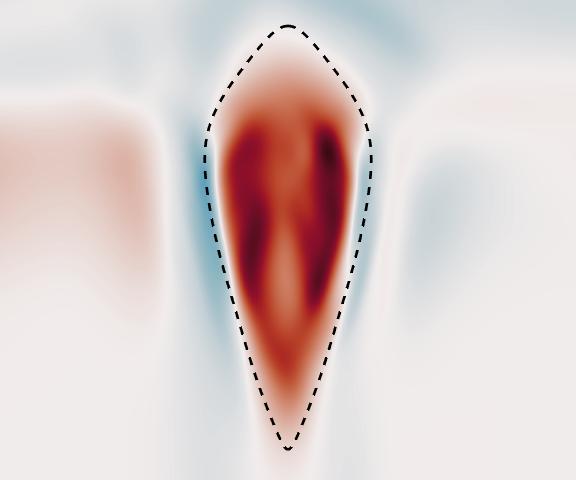 Stable three-dimensional vortex families consistent with Jovian observations including the Great Red SpotJournal of Fluid Mechanics, 2024
